Socialization & Confidence
Socialization isn't about your puppy meeting everyone. It's about teaching them how to experience the world confidently without feeling the need to react to everything in it.
When people hear the word socialization, they often think their puppy needs to meet lots of people, play with lots of dogs and go everywhere possible.
That's not what I'm looking for.
For a Rottweiler, I want to build confidence, neutrality and engagement with YOU.
Your puppy should learn that new people, dogs, sounds, places and experiences are simply part of life.
They can notice them without being afraid of them—and without believing they need to run over and investigate every single one.
Socialization Doesn't Mean Meeting Everyone
A well-socialized puppy doesn't need to:
- greet every person they see
- play with every dog they meet
- be petted by every stranger
- investigate every new thing
- participate in everything happening around them
Sometimes the best socialization is simply:
See it. Notice it. Realize it's no big deal. Move on.
That's an important skill for any dog, but especially for a Rottweiler who is going to grow into a large, powerful adult.
Exposure Does NOT Have to Mean Interaction
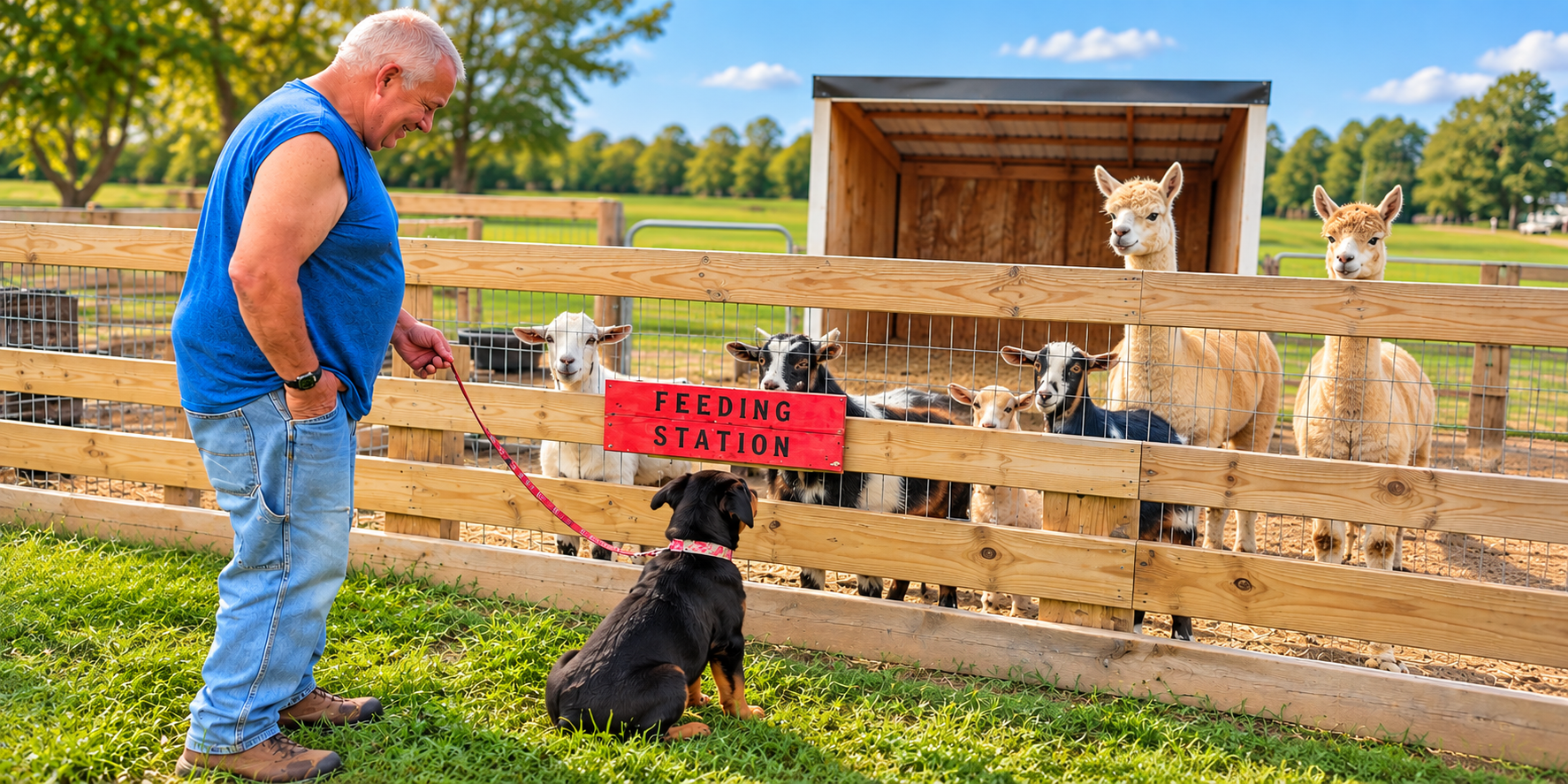
Your puppy can learn from an experience without actually interacting with it.
They can:
- see another dog without meeting it
- watch children playing without joining them
- walk past people without being petted
- hear an unfamiliar noise without needing to investigate it
- ride in the car and see new surroundings
- experience different surfaces, sights and sounds
- visit a new place without greeting everyone there
You're teaching your puppy:
“I saw it. It wasn't a big deal. We moved on.”
That is socialization too.
YOU Should Still Be the Most Important Thing in the Room
Before worrying about perfect obedience, start building engagement.
When your puppy voluntarily looks at you, follows you, approaches you or chooses to check in with you instead of becoming completely absorbed by a distraction—
reward it.
Praise them. Play with them. Give them a treat. Continue moving together.
You're teaching:
“Checking in with my person is always a good idea.”
That simple habit becomes incredibly valuable as your Rottweiler grows.
It's the same idea we talked about in leash training:
The person on the other end of the leash matters.
Build Confidence—Don't Make Fear a Big Event
If your puppy is unsure or startled by something, stay calm yourself.
Don't panic.
Don't immediately scoop them up.
And don't make a huge production out of it with frantic petting and repeated “It's okay! It's okay! It's okay!”
Your puppy is watching you, too.
If something startles them, I want you to be calm and matter-of-fact. Give them enough distance to look at whatever concerned them. Let them think and process.
Encourage curiosity when they're ready for it. Praise or reward them when they relax, investigate appropriately or check back in with you.
At the same time, don't drag them toward something they're frightened of just to prove it won't hurt them.
There's a difference between helping a puppy work through uncertainty and forcing them into it.
If they're too uncomfortable to recover, create more distance and try something easier another time.
What I want the puppy learning is:
“That surprised me. My person isn't worried. I can look at it, figure it out and move on.”
Real-Life Socialization Starts at Home
You don't have to take your puppy somewhere special every day to socialize them.
Your own home can provide all kinds of experiences.
Think about everything your puppy may encounter:
Vacuum cleaners. Doorbells. Television. Different flooring. Stairs. Visitors. Delivery trucks. Lawn equipment. Grooming. Nail trims. Car rides. Household noises. People coming and going.
And you can deliberately introduce sounds your puppy may not hear very often.
Alexa can actually be a useful training tool.
You can play sound effects such as:
- fireworks
- thunderstorms
- sirens
- traffic
- children playing
- crowds
- construction noises
- other unfamiliar sounds
Start at a low, comfortable volume while your puppy is doing something normal. As they become comfortable with it, you can gradually increase the volume during future sessions.
Don't start with fireworks blasting through the house at full volume. 😂
The idea is exposure—not scaring them.
Fireworks recordings can be especially useful before the Fourth of July. I'd much rather a puppy hear those sounds in a controlled setting first than have their first experience be when the entire neighborhood suddenly starts exploding.
And think about your own household.
If everyone in your house is generally quiet and soft-spoken, give your puppy opportunities to experience something different.
Have periods when the television is louder. Let them hear loud people, cheering, action scenes and even things such as gunshots on television or through sound effects—starting at a reasonable volume.
We're not trying to make the house chaotic.
We're teaching:
“The world isn't always quiet, and that's okay.”
Use Real Life When You Can
Some of the best socialization opportunities aren't manufactured at all.
Holiday gatherings are a great example.
I've taken a young dog or puppy to a family gathering and simply kept them on a leash near me.
They don't have to work the room.
They don't need to be passed from person to person.
And everybody there doesn't need to pet them.
Instead, the puppy gets to experience people talking, laughing, children moving around, doors opening and closing, food smells, different voices, chairs moving and all the general commotion that comes with a house full of people.
I'm not hiding the puppy from the experience.
But I'm also not throwing them into the middle of it.
I'm creating a safe situation where they can observe, process and learn.
They get to experience all those new sights, sounds and smells while staying near the person they trust.
That is socialization.
People Don't Have to Pet Your Puppy
Rottweiler puppies attract attention.
People see that little black-and-mahogany puppy and naturally want to come over, talk to them and pet them.
You are not required to let strangers pet your dog.
That's worth saying again because sometimes owners feel rude saying no.
It is perfectly okay to say no.
Your puppy does not need to learn that every person they see is someone they should approach—or someone who is entitled to touch them.
It's perfectly fine to say:
“We're training right now, so we're not saying hello.”
And keep walking.
You're not hiding your puppy from people. Your puppy can see people, hear them, walk through a crowd and experience normal activity without being handled by everyone they meet.
In fact, that's an important part of socialization.
I want the puppy learning:
“There are people everywhere. That's normal. I don't have to go meet all of them.”
If You DO Let Someone Pet Your Puppy
Be prepared to tell them how you want them to approach and touch your puppy.
Don't assume someone knows how to greet a dog just because they tell you:
“Oh, I love dogs!”
I've had strangers want to hug my dogs.
No.
Wrapping your arms around a dog's neck or body, leaning over them or putting your face right next to theirs can make a dog uncomfortable or feel trapped.
If you're going to allow someone to pet your puppy, don't be afraid to quickly give them a little direction:
“Let him come to you.”
“Pet him on the chest or side.”
“Please don't hug him.”
“Don't get right in his face.”
Keep the greeting calm and give your puppy room to move away if they want to.
And while it's happening:
Watch your puppy—not the person.
Is your puppy loose and comfortable?
Are they choosing to stay there?
Or are they turning their head away, backing up, becoming stiff, trying to move behind you or otherwise telling you they've had enough?
If your puppy is uncomfortable, end the interaction.
You don't owe a stranger additional time with your dog just because you initially said yes.
The goal isn't to teach your puppy:
“I have to tolerate whatever a stranger wants to do to me.”
It's:
“My person decides who interacts with me, and my person will help make sure those interactions are appropriate.”
Be Selective With Other Dogs
Your puppy does not need to play with every dog they meet.
And I personally do not recommend dog parks.
You don't know the dogs.
You don't necessarily know the owners.
You don't know how well those dogs have been trained or socialized.
And unfortunately, not everyone recognizes the early body-language signals that a dog is uncomfortable, overstimulated or asking another dog for space.
By the time someone realizes there's a problem, the dogs may already be well past the first several warnings.
I'd much rather choose my puppy's interactions.
A calm, socially appropriate dog that you know can provide a much better experience than putting your puppy into a group of unfamiliar dogs and hoping everybody behaves.
One of the most valuable things your puppy can learn around another dog is:
SEE ANOTHER DOG. STAY CALM. KEEP GOING.
Your puppy can see another dog and learn:
“There's a dog over there. That's okay. We're still doing our thing.”
Your puppy doesn't need a dog park to learn how to behave around other dogs.
Socialization While Your Puppy Is Still Young
There's a balance here.
Young puppies benefit from experiencing the world, but they're also still completing their vaccinations.
That doesn't mean your puppy has to live in a bubble.
It does mean you should be thoughtful about where you take them and what you expose them to.
Avoid areas where large numbers of unknown dogs eliminate or congregate, and don't put a young puppy into uncontrolled situations with unfamiliar dogs.
There are still plenty of ways to introduce your puppy to the world—car rides, visitors at home, controlled outings, watching activity from an appropriate place, different sounds and surfaces, and carefully selected people and dogs.
Socialization should be thoughtful, not reckless.
Different Surfaces Build Confidence
Puppies learn with their feet, too.
Grass feels different from concrete.
Concrete feels different from gravel.
A wooden porch feels different from tile.
Stairs, mats, uneven ground and other safe surfaces all give your puppy opportunities to learn how their body works and become comfortable navigating new environments.
If your puppy hesitates, don't drag them across it.
Encourage them.
Let them investigate.
Reward the attempt.
Confidence comes from figuring things out successfully.
Let Your Puppy Observe
Your puppy doesn't always need to be in the middle of what's happening.
Sometimes they can just watch.
They can sit with you and watch people go by.
Watch children play.
Watch another dog at a distance.
Listen to traffic.
See someone riding a bicycle.
Watch the delivery truck pull into the driveway.
Nothing has to happen.
That's actually part of the lesson.
Something new can happen without your puppy needing to react to it.
Learn to Read YOUR Puppy
Socialization isn't a checklist.
Two puppies can experience exactly the same situation and feel very differently about it.
Watch your puppy's body language.
Are they loose and curious?
Are they willingly taking treats?
Are they checking in with you?
Are they sniffing and exploring?
Or are they trying to get away?
Have they stopped taking food they normally love?
Are they tucked behind you?
Is their body becoming stiff?
Are they fixated on something?
Are they becoming increasingly frantic, mouthy or unable to settle?
Your puppy is giving you information. Pay attention to it.
You don't have to immediately remove your puppy from every situation because they hesitate.
Sometimes they simply need a moment to look and figure something out.
But you also shouldn't ignore a puppy who is clearly telling you:
“This is too much for me right now.”
Create more distance.
Make the situation easier.
Let them observe from somewhere they feel more comfortable.
Or call it a day and try again another time.
That's not failing at socialization.
That's good socialization.
The goal isn't to see how much your puppy can tolerate.
The goal is to give them experiences they can successfully process and learn from.
Don't Overdo It
More socialization isn't automatically better socialization.
Puppies need plenty of:
Sleep. Routine. Quiet time.
A short, positive experience followed by a good nap can be far more beneficial than hours of stimulation.
If your puppy is becoming increasingly wild, mouthy, unable to focus, frantic or just plain DONE, adding another experience probably isn't going to improve anything.
Sometimes your puppy doesn't need more socialization.
Sometimes your puppy needs a nap. 😂
Quality over quantity.
Don't Accidentally Teach Excitement
This is something people don't always think about.
If every time your puppy sees another dog you rush over for a play session...
If every person they see pets them...
If every new place becomes a huge exciting adventure...
your puppy may begin to expect interaction every time.
Then that little puppy grows into an adult Rottweiler who sees something interesting and thinks:
“DOG! PERSON! SOMETHING NEW! LET ME GO SEE IT!”
That's not what we're trying to build.
We want:
“I see it. No big deal. What are we doing?”
There's a big difference.
The Spartan Rule
Before introducing your puppy to a new situation, ask yourself:
“What do I want my ADULT Rottweiler to do here?”
Then start teaching that behavior now.
At a holiday gathering, do I want my adult Rottweiler dragging me around trying to greet 25 people—or lying near me calmly watching everything?
When a stranger approaches us, do I want my adult dog assuming they're entitled to run over for attention—or looking to me for direction?
When another dog walks by, do I want:
“DOG! DOG! DOG!”
or:
“I see it. ... What are we doing?”
When fireworks go off, a truck backfires or someone drops something, do I want every unexpected sound to become a major event—or a dog who notices it, looks to me and recovers?
That cute little puppy is going to become a powerful adult dog.
Start building the habits you want now.
And remember:
What's cute at 10 pounds may not be quite as cute at 100 pounds. 😂
What Are We Ultimately Trying to Build?
I want your Spartan Rottweiler growing into a dog who is:
Confident.
Calm.
Observant.
Neutral when appropriate.
Comfortable experiencing new things.
And engaged with YOU.
Your puppy doesn't need to believe the whole world is their playground.
They need to learn how to confidently live in it.
So keep it simple.
Let them experience things.
Don't overwhelm them.
Give them time to process.
Let them observe.
Reward them for checking in with you.
Choose interactions carefully.
Watch their body language.
And remember that not interacting is sometimes the lesson.
Socialization isn't about showing your puppy everything in the world. It's about teaching your puppy what to do when the world shows them something new.