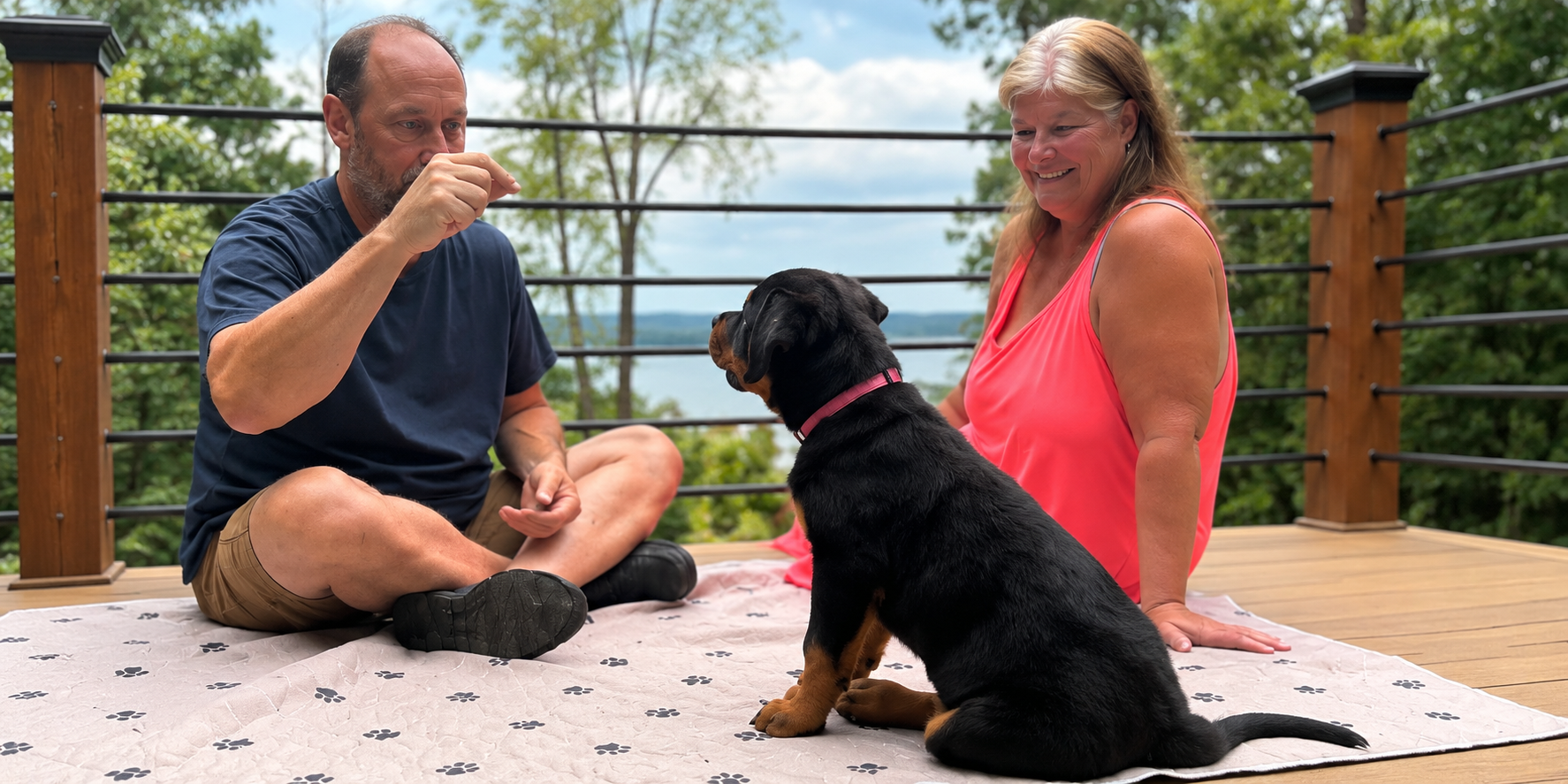
Basic Commands & Everyday Manners
Good training starts with communication—not a long list of commands.
Before worrying about how many commands your puppy knows, concentrate on getting their attention and teaching them that listening to you is worth it.
Keep training short, clear and consistent. A few minutes several times throughout the day is plenty for a young puppy.
And remember—you don't have to schedule a “training session” every time you teach something. Meals, doors, walks, playtime, kennel time and simply moving around the house are all opportunities to train.
First—Get Them to “Report for Work”
Before giving a command, get your puppy's attention.
Say their name once.
When they look at you, praise or reward them.
You're teaching:
“When my person talks to me, I should pay attention.”
Don't get into the habit of repeating their name or a command over and over until they finally respond.
If you say:
“Sit... sit... sit... SIT!”
you've just taught your puppy that the first three don't really count.
Say it once. Give them a moment to think. Then help them succeed.
Rottweilers Like Having a Job
Rottweilers are working dogs. They generally do well when they understand that you expect something from
them instead of simply rushing through life doing whatever comes next.
That doesn't mean your puppy needs to be “working” all day. I use ordinary moments throughout the day
to give them small jobs.
Before you pet them, ask for a Sit.
Before putting down their food, ask for a Sit or Wait.
Before opening a door, ask them to Wait.
Before throwing the toy, ask for a simple command.
Even affection can become part of training. If your puppy comes over wanting attention, ask for something simple that they already know. When they do it, then give them the petting and praise they wanted.
I even do this at bedtime.
My dogs don't just hear “Kennel” and charge through the kennel door. I have them stop and Sit first.
I want them to pause, look at me and make eye contact.
They wait for me.
Then I give them permission:
“OK... Kennel.”
Now going into the kennel isn't just something the dog is doing. They're paying attention,
waiting for direction and then following through.
Those little moments add up.
You're teaching your puppy that looking to you for direction is simply part of everyday life.
Teach the Action—Then Give It a Name
This is one of the biggest things I want owners to understand.
Your puppy doesn't know what the word “Sit” means until you teach them.
First, get the puppy to perform the action you want. You might use a treat, your hand,
your body movement or simply catch them doing it naturally.
The instant they do it, name it:
“Sit.”
Praise and reward.
Then do it again.
Get the action. Name it. Reward it.
Repeat.
You're connecting the word to something the puppy is already doing.
You can also catch good behaviors throughout the day.
Your puppy lies down on their own?
“Down.”
Your puppy comes toward you?
“Come.”
Your puppy happens to sit while waiting for something?
“Sit.”
See what they did—and name it.
Once your puppy begins making that connection, you can start giving the word before the action and see whether they understand what you're asking.
SIT
Start by getting the behavior.
Use a treat to guide your puppy's nose slightly up and back. As their head comes up,
their bottom will naturally tend to go down.
The moment that bottom hits the floor:
“Sit.”
Praise and reward.
Repeat it several times.
As your puppy begins connecting the word with the action, start saying “Sit” first and give them a moment to respond.
Remember—don't immediately repeat yourself.
Let them think.
DOWN
Start with your puppy sitting or standing.
Bring a treat toward the floor and slowly move it away from them. As they follow it,
encourage them into the down position.
As soon as they're completely down:
“Down.”
Praise and reward.
Don't push or force your puppy to the floor. We want them learning what the behavior means
—not simply being physically put into position.
Once they're making the connection, begin asking for Down before helping them into the position.
COME
Start easy and make coming to you worth it.
When your puppy is already moving toward you, that's a perfect opportunity:
“Come!”
Then praise and reward them when they reach you.
As they begin understanding the word, start asking for Come from short distances with very few distractions.
There will be times when your puppy has done something they shouldn't and you need them to come to you.
That's okay.
What I don't want you to do is stand there angry and yell:
“COME HERE!”
in the voice that tells the puppy they're about to be in trouble.
Think about what that teaches them. If coming to you repeatedly ends with anger or punishment,
why would they be excited to come the next time you call?
Even if you're frustrated, call them in a normal, pleasant voice.
When they come, don't turn coming to you into the punishment.
Deal with whatever happened. Pick up the shoe. Move the trash can.
Take away whatever they shouldn't have. Redirect the puppy and show them what you want them to do instead.
And remember—by the time you've discovered what happened, your puppy may have no idea why you're angry.
Sometimes we have to train ourselves, too.
If the puppy keeps getting into the trash, maybe the trash needs to be somewhere they can't reach it.
If they're chewing shoes, maybe we need to stop leaving shoes where the puppy can get them.
If they're having accidents because we lost track of time, that's information for us too.
Training isn't only about correcting the puppy after something goes wrong.
A big part of good training is setting things up so your puppy has a better chance of getting it right in the first place.
And remember, “Come” is not the same thing as our special “Puppy, puppy, puppy!” recall. We keep that special recall separate and highly rewarding so it doesn't become everyday background noise.
LEAVE IT
Leave It means:
“Don't take that.”
Start with something your puppy wants but doesn't need to have.
Help them make the choice to leave it alone. The moment they back away or turn their attention to you:
“Leave it.”
Praise and reward.
As they understand what those words mean, begin giving the command before they go after the object.
Don't make every practice session a battle over something extremely exciting.
Teach the concept with easier items first and gradually make it harder.
DROP IT
Drop It means:
“Let go of what is already in your mouth.”
That's different from Leave It.
Instead of chasing your puppy around the house trying to pry something away, teach them that releasing an item can pay.
Offer an appropriate trade. When the puppy releases what they have:
“Drop it.”
Praise the release and pick up the item.
As they learn the behavior, begin asking for Drop It before presenting the trade.
This will eventually tie in with our “Treat!” Game, which has its own guide.
WAIT
Start with a short wait while your puppy is learning what you're asking. But once they understand the command,
vary the amount of time they have to wait.
I use Wait when I want a temporary pause—at doors, before putting down a food bowl,
before getting out of a vehicle or before going through a gate.
We're human. Without realizing it, we'll fall into a pattern:
“Wait... one... two... three... OK!”
Do that often enough and your dog isn't necessarily waiting for you anymore.
They're learning your timing.
Pretty soon they're releasing themselves because they know what usually comes next.
Sometimes make the wait short.
Sometimes make it longer.
Sometimes stand there for a moment before giving the release.
It needs to be more than a curtsy—but it doesn't always have to be a long bow.
What matters is that your dog isn't watching the clock in their head.
They're watching you.
The command isn't:
“Wait for five seconds.”
It's:
“Wait until I release you.”
That's why the release word matters.
They shouldn't decide when the Wait is finished. I do.
PLACE
Place means go to a particular spot and stay there until you're released.
That spot might be a raised platform, a dog bed or another clearly defined area.
I use this every day with my own dogs.
When they're out playing in the play yards and it's time to come inside, I tell them:
“Place.”
They go to their platforms and wait.
And here's the part I love—they're watching me.
They're waiting for what comes next because they know the routine.
Then they hear:
“OK!”
That's their release to leave their platforms and come to me.
And they LOVE it.
To them, this isn't some boring obedience exercise. It's a job. They know what they're supposed to do,
they're watching for the next direction, and they're excited when they get that release.
That's what I want owners to understand about training a Rottweiler.
Training doesn't have to feel like constant correction. It can become a game between you and your dog.
Don't Forget the Release Word
Teaching your dog what to do is only half of it.
They also need to know when they're finished doing it.
For my dogs, that word is:
“OK.”
If I ask them to Wait, Place, or pause before entering their kennel,
I don't want them deciding on their own when they're finished.
They wait for me.
“OK” means the job is finished—you may move.
That little release word becomes surprisingly important because it gives your dog a clear beginning
and end to what you're asking.
Everyday Manners Matter Too
A puppy can know Sit and still be pretty difficult to live with!
Some of the most important training happens in ordinary moments.
Teach your puppy to:
- Wait instead of barging through doors.
- Keep four feet on the floor instead of jumping on people.
- Walk with you instead of dragging you.
- Settle when nothing exciting is happening.
- Leave clothing, hands and household items alone.
- Accept handling of their feet, ears and mouth.
- Go into their kennel calmly.
- Pay attention to you even when something else looks more interesting.
These aren't fancy tricks.
These are the behaviors that make a 100-pound adult Rottweiler pleasant to live with.
Don't Forget to Reward the Good Stuff
We tend to notice puppies when they're doing something wrong.
They steal the shoe—there we are.
They jump on us—there we are.
They grab the dish towel—there we are again.
But what about when they're lying quietly beside you? Walking nicely?
Looking at you on their own? Sitting instead of jumping?
Notice that too.
You don't always need a treat. Praise, attention, play and getting something they wanted can all tell your puppy:
“Yes. That's exactly what I wanted.”
Keep It Simple
You don't need an hour-long training session.
A few good repetitions are enough. Stop while your puppy is still interested and work training into normal life.
Most importantly, be consistent.
If jumping isn't allowed today, it shouldn't suddenly be hilarious tomorrow because Grandma came over.
Your puppy doesn't need perfection from you.
They need clear expectations, repetition and someone willing to keep teaching.
And if you remember nothing else from this guide, remember this:
Get their attention. Give them a job. Show them what you want. Name it. Practice it. And let them know when the job is finished.
← Back to Puppy Training & Good Habits