Crate Training Your Puppy
Crate training isn't optional around here
—and your Spartan puppy already has a head start.
Before your puppy ever leaves us, we've already started having them sleep alone in their own kennel.
That doesn't mean they're going to arrive at your house, march happily into a brand-new kennel and never have an opinion about it. 😂
Remember, they've just left their littermates, the place they were raised and everything familiar to them.
You're not starting from scratch.
You're continuing what we've already started.
Why Crate Training Matters
A kennel is one of the most useful tools you'll have during puppyhood—and honestly, throughout your dog's life.
It gives your puppy a defined place to rest and settle while also helping you manage everyday life.
I use the kennel for:
- Sleeping at night
- Naps and settle time
- Potty training
- Times when the puppy can't be supervised
- Preventing chewing and getting into things they shouldn't
- Teaching a puppy that they can be alone for a while
- Travel and overnight stays
- Preparing them for times they may need to be kenneled at a veterinarian, groomer or boarding facility
The kennel isn't where your puppy goes because they're “bad.”
It's simply part of their everyday routine.
Choose the Right Size
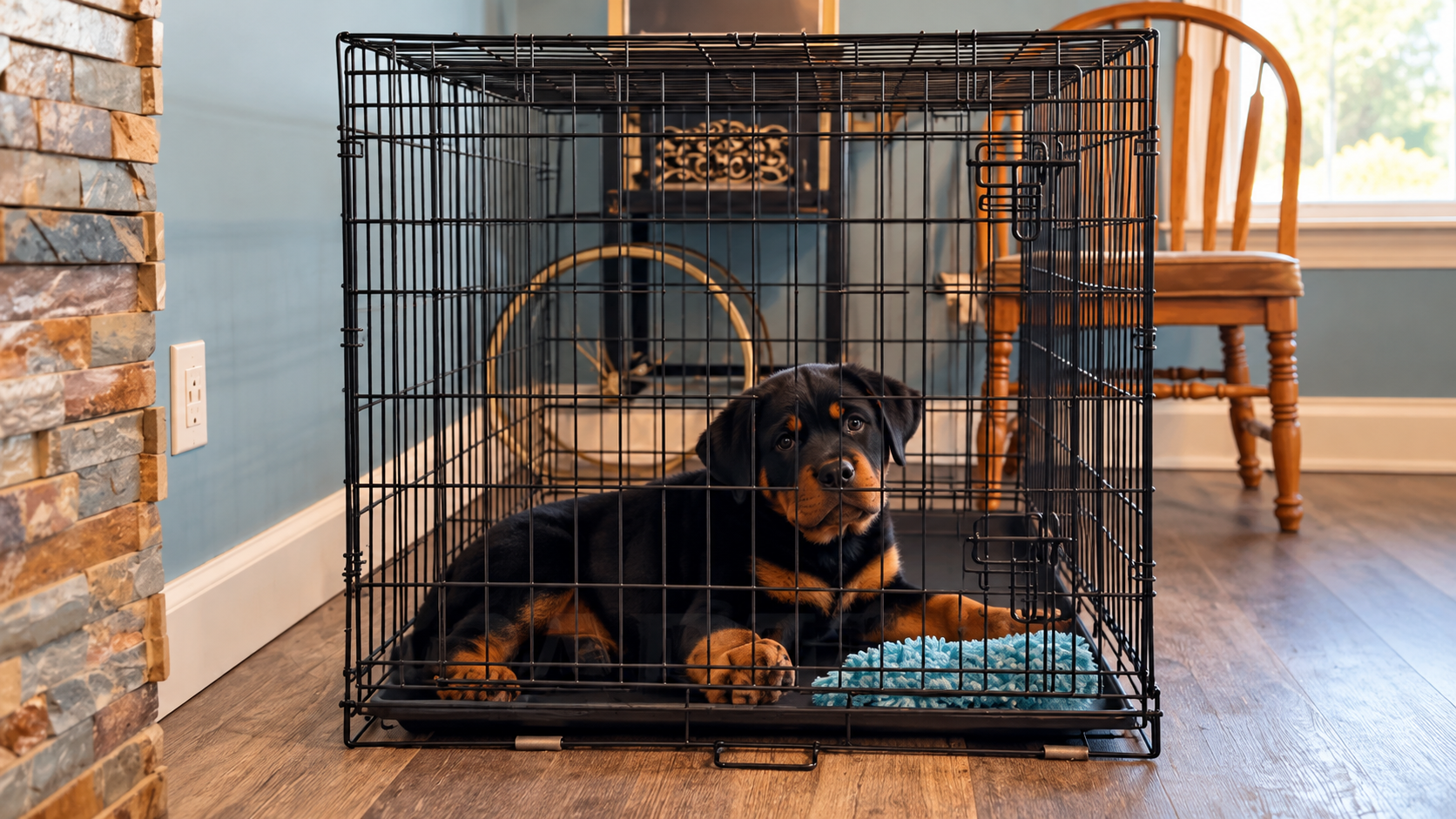
Rottweilers grow quickly, so I like a larger kennel with a divider that can be moved as the puppy grows.
Your puppy should have enough room to comfortably stand up, turn around and lie down.
They don't need their own studio apartment.
Too much room can work against you during potty training because some puppies will use one
end as a bathroom and sleep at the other.
Move the divider as your puppy grows.
Keep the Kennel Simple During Potty Training
While your puppy is still potty training, I don't put bedding in the kennel.
No rug. No pillow. No fluffy kennel bed.
Bedding can absorb an accident, and some puppies will potty on it and simply move to another spot.
Instead, keep the kennel simple.
A safe chew toy or a soft, pet-friendly stuffed animal can give your puppy something to do
or snuggle with without filling the kennel with bedding.
Of course, know your puppy. If they're tearing pieces off a toy or trying to eat it,
don't leave it with them unsupervised.
The fluffy beds and pillows can come later.
Right now we're working on:
Sleep here. Keep it clean. Potty outside.
Use the Kennel During the Day Too
Don't make the kennel something your puppy only sees at bedtime or when everybody leaves the house.
Use it as part of the normal day.
After potty, play or a little training is a great time for your puppy to have some kennel time and settle.
Whenever possible, take your puppy outside to potty before putting them in the kennel.
We're trying to set them up to succeed. An empty bladder and a puppy who's ready to settle
make kennel time a whole lot easier.
And sometimes put your puppy in the kennel while you're still home.
You might be cooking dinner, cleaning the house, watching television or working nearby.
Your puppy needs to learn:
“I can be by myself for a while, and that's okay.”
They don't have to be involved in everything you're doing.
Make Going In a Normal Thing
You don't need to make a big production out of putting your puppy in the kennel.
You can use a treat, praise and calm encouragement while they're learning your routine.
Eventually, going into the kennel should become just another everyday behavior—like Sit, Place or Wait.
In our house, bedtime itself becomes a little job:
Sit → look at me → Wait → “OK... Kennel.”
We're not negotiating about whether it's bedtime.
We're just going to bed.
What About Crying?
Yes. Your puppy may complain.
They may whine. They may fuss. They may give you their very best:
“Excuse me. There has clearly been a mistake.” 😂
Your puppy was already sleeping alone before coming home, but now they're in
a new house, new kennel and new routine.
Give them an opportunity to settle.
You don't want to teach them that every little complaint immediately opens the kennel door.
At the same time, use common sense. A young puppy may genuinely need to potty, especially during the night.
You'll start learning the difference between:
“I need something.”
and
“I would simply prefer to be out there with you.”
If you're not sure whether your young puppy needs to potty, take them out—but make it boring.
Leash on. Outside. Give them an opportunity to potty.
If they go, great. Praise them and head back to the kennel.
If they don't, head back to the kennel anyway.
We're answering a possible bathroom need without teaching them that crying at night starts playtime.
Nighttime Means Bedtime
Your puppy should sleep in their kennel at night.
Keep the routine calm and predictable:
Bathroom → Kennel → Lights down → Bedtime
Your puppy has already been introduced to sleeping alone before leaving us. We also use music when they're learning to sleep in their individual kennels, so some quiet background sound at your house may help keep that routine familiar.
If your puppy genuinely needs a nighttime potty break:
Outside → potty → back to the kennel.
No playing. No wandering around the house. No deciding that 2:17 a.m. would be a wonderful time to start the day.
Business trip. Then back to bed.
Don't Use the Kennel as Punishment
Don't angrily send your puppy to the kennel because they've done something wrong.
That doesn't mean there won't be times when the puppy needs to go into their kennel.
Maybe you can't supervise them.
Maybe they're overtired.
Maybe they're getting into everything.
Maybe you need twenty minutes without a Rottweiler puppy attached to your pants. 😂
That's okay.
Put them in calmly and matter-of-factly.
Kennel time is simply part of life.
Kids and the Kennel
If you have children, teach them that when the puppy is in the kennel resting, leave them alone.
Don't poke fingers through the door.
Don't crawl into the kennel with them.
Don't keep calling them.
Don't tease them with toys.
Your puppy needs to learn that their kennel is a place where they can settle and rest without constantly being disturbed.
Don't Give Too Much Freedom Too Soon
One of the biggest mistakes with a new puppy is giving them the run of the house before they're ready for it.
If you can't actively supervise your puppy, the kennel or another appropriate confined area can keep them from practicing behaviors you don't want.
Every shoe they chew, every trash can they raid and every potty accident they sneak off to have is something we could have prevented with a little more supervision or structure.
Remember—sometimes we have to train ourselves, too.
Freedom is earned.
As your puppy matures and shows you they can handle more responsibility, gradually give them more.
The Kennel Travels Too
A dog who is accustomed to a kennel is much easier to manage when life takes you somewhere besides home.
Vacations. Hotels. Visiting family. Boarding. Veterinary stays. Emergencies.
Their surroundings may change, but the kennel itself is something familiar.
You won't necessarily take the same kennel everywhere for the rest of your dog's life, but teaching your puppy to be comfortable with confinement is a skill that can be useful throughout their life.
Keep It Simple
Crate training doesn't need to be complicated.
Use the kennel every day.
Use it while you're home sometimes.
Give your puppy opportunities to settle.
Keep bedtime predictable.
Take care of genuine potty needs.
Don't reward every complaint by opening the door.
Don't use the kennel angrily as punishment.
And don't give your puppy more freedom than they're ready to handle.
Your puppy already knows what a kennel is.
Now you're simply teaching them:
“This is how we do it at your new home.”
How Long Can My Puppy Stay in the Kennel?
There isn't one magic number that works for every puppy.
A young puppy needs frequent bathroom breaks, activity, interaction and opportunities to move around.
The kennel is a training and management tool—not where your puppy should spend most of their day.
Pay attention to your puppy's age, potty habits and daily routine.
If you're regularly asking your puppy to hold it longer than they're capable of, you're making potty training harder—not easier.
Before long, going into the kennel isn't a big event at all.
It's just part of their day.