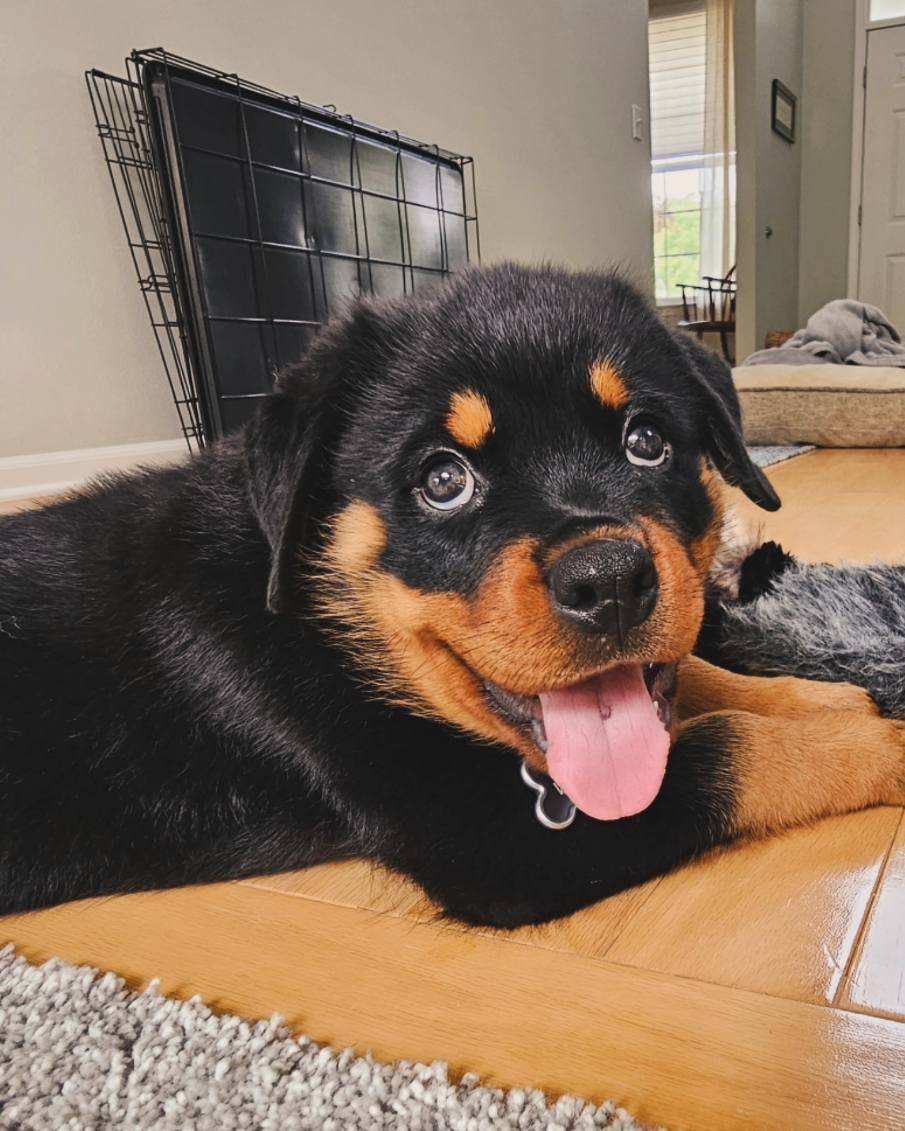

Bringing Your Puppy Home
You’re home! Now the fun really begins.
Your puppy has just left everything familiar—me, their littermates, their normal routine, smells and surroundings—and walked into an entirely new world.
You’re excited. The family is excited. And everybody probably wants to love on the new puppy.
For your puppy, though,
the best first day is usually a pretty quiet one.
Start Small
When you arrive home, take your puppy directly to the area you’ve chosen for potty time.
After that, let them begin exploring—but don’t give them the run of the entire house right away.
Start with a small area where you can stay with them. There will be plenty of time to explore the rest of the house
one room at a time.
Too much space, too many people and too much excitement all at once can be overwhelming.
Meeting the Family
Try not to turn your puppy’s arrival into a welcome-home party.
Let family members meet the puppy calmly. With young children, I prefer having them sit down and allowing the puppy to come to them. Always supervise children and puppies together.
And as tempting as it is to invite friends and neighbors over to meet your new Spartan puppy
-give your puppy a little time to settle in first.
🐾 House Rules Start on Day One
Your puppy doesn’t know your house rules yet. It’s your job to teach them.
Decide ahead of time:
- Is the puppy allowed on the furniture?
- Where will the puppy sleep?
- Are table scraps allowed?
- What happens when the puppy grabs clothes or puts those puppy teeth on someone?
- Which areas of the house are off-limits?
I always tell people:
What is cute at 10 pounds may not be nearly as cute at 100 pounds.
You don’t have to be harsh. You do need to be clear and consistent.
Praise the behavior you want, interrupt and redirect behavior you don’t want, and make sure everyone in the family follows the same rules.
Meeting Your Other Dogs
Don’t simply turn everyone loose together and hope for the best.
Keep those first introductions controlled and supervised. Remember, your puppy is still learning dog manners,
and an adult dog may correct an overly enthusiastic puppy.
A growl from an adult dog isn’t automatically a bad thing—it can simply be communication. But if either dog becomes overly excited, frightened or agitated, separate them and give everyone a break.
They don’t have to become best friends in the first 20 minutes.
😴 Let That Puppy SLEEP!
One thing that surprises some new owners is just how much a young puppy sleeps.
They play. They eat. They explore for a few minutes...
And then they’re OUT. 😴
Young puppies spend a huge portion of their day sleeping. While it may look like they’re “doing nothing,” their little bodies and brains are busy growing and developing.
That’s why I don’t try to keep a tired puppy awake just because everyone wants a little more puppy time.
If your puppy falls asleep—let them sleep.
Those little bursts of energy will get longer every week.
Enjoy the quiet while it lasts!
👀 Watch What Your Puppy Is Telling You
Your puppy can’t tell you, “I’ve had enough for today,” but their body language can.
Watch for signs that your puppy is getting tired, overwhelmed or simply needs a break. They may turn away, avoid interaction, become extra mouthy, get the zoomies, start whining, retreat to their kennel or just flop down and go to sleep.
Don’t feel like you have to keep your puppy entertained.
Sometimes the best thing you can do is recognize that they’ve had enough and give them some quiet time.
Want to learn more? → Understanding Your Puppy’s Body Language
Start Your Routine Right Away
Puppies do very well when life becomes predictable.
Start establishing regular routine for:
- Meals
- Potty trips
- Play and short training sessions
- Naps and kennel time
- Bedtime
It doesn’t have to run like a military schedule. You’re simply beginning to teach your puppy what order
a normal day in your home looks like.
🌙 The First Night
Remember—your puppy has already started sleeping alone in their own kennel before leaving me.
So the kennel itself isn’t completely new.
The new part is your house.
Some puppies settle right in. Others may complain about the new arrangement for a night or two.
Take your puppy out to potty immediately before bedtime and then put them in their kennel.
If you believe they genuinely need to potty during the night, make it a quick, boring potty trip—no playing and no middle-of-the-night party. Then it’s right back to bed.
And one little warning...
If you bring that crying puppy into your bed, you’d better be prepared for a 100-pound Rottweiler who remembers exactly where they’re supposed to sleep. 😂
🩺 Schedule Your First Veterinary Visit
You’ll receive your puppy’s health and vaccination information from me.
Go ahead and establish your puppy with your veterinarian and schedule their first visit. Bring the records I send home so your veterinarian knows exactly what your puppy has already received and when.
❤️ Give Them a Little Time
Your puppy doesn’t need to learn everything on Day One.
They need to learn something much simpler first:
This is home.
These are my people.
I’m safe here.
Keep things calm, establish your boundaries, begin your routine and give your puppy plenty of opportunities to rest.
You’ll have plenty of time for everything else.