Should a Rottweiler have a tail, or should it be docked?
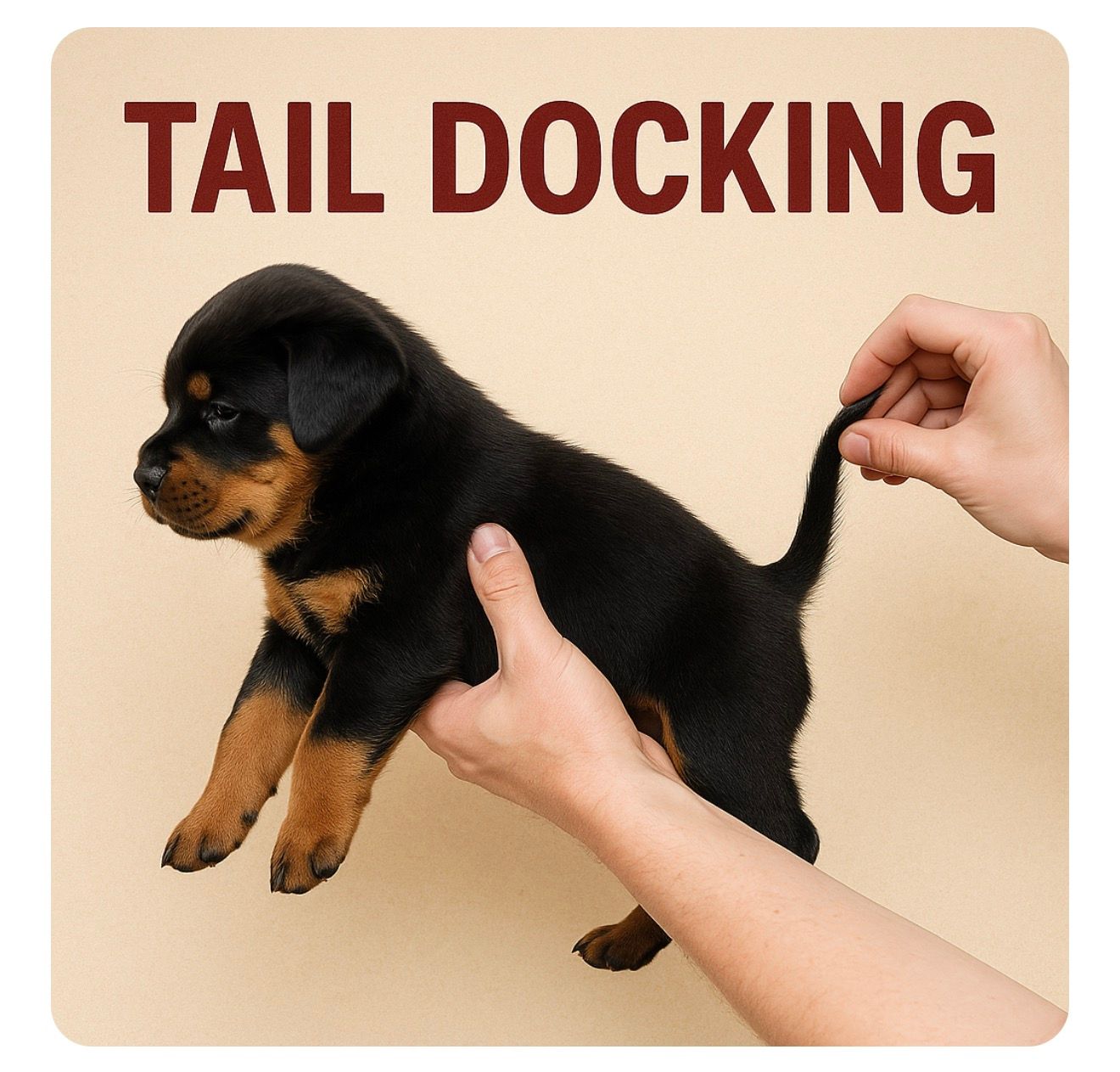
The Rottweiler is one of the most recognizable dog breeds in the world—but one of the biggest debates you'll see in modern Rottweiler circles is this:
Should a Rottweiler have a tail, or should it be docked?
As a breeder who has worked with this breed for many years, and one who makes education and transparency a priority, I want to break down the history, the facts, and how we handle tail docking in our program today.
This is not about judgment or controversy. It's about giving families the information they need to feel confident and comfortable with whichever option they prefer.
Why Were Rottweiler Tails Traditionally Docked?
Traditionally, Rottweiler tails were docked for very practical working reasons. These dogs originally served as:
- Livestock drovers
- Butcher’s dogs
- Cart pullers
- Property guardians
In those environments, a long tail was more prone to:
- Crushing under wagon wheels
- Getting stepped on by cattle
- Being caught in equipment
- Breaking during rough, high-impact work
Docking wasn’t originally about appearance—it was about protecting working dogs from injuries.
Over time, as Rottweilers moved from working farms to family homes and show rings, docking became part of the American breed standard and the classic look people recognize.
How Different Parts of the World View Docking
Depending on where you live, both tail types are considered “correct.”
United States (AKC)
The American Kennel Club still lists a short, docked tail as part of the official breed standard.
Europe (FCI/ADRK)
Docking is banned in many countries, so natural tails are required in the show ring.
Reality Today
A Rottweiler with a docked tail is no more “authentic” than a Rottweiler with a natural tail.
The difference is purely regional style and tradition—not quality.
Does Tail Length Affect Temperament, Prey Drive, or Behavior?
Absolutely not.
Whether a Rottweiler has a natural tail or a docked one has zero effect on:
- Prey drive
- Trainability
- Temperament
- Confidence
- Working ability
- Nerve strength
Those traits come from genetics, socialization, and breeder handling—not tail length.
Is Docking Painful? Let’s Clear This Up.
This is the part families always ask about, and it deserves honest explanation.
When done incorrectly—or by someone untrained—docking
can be harmful.
But when done correctly, at the correct age, and with the right technique, it is extremely low-stress for the puppy.
The key is method and timing.
And that brings us to how we dock tails here at Spartan Rottweilers.
How We Humanely Dock Tails at Spartan Rottweilers
Over the years, docking techniques have evolved. We have extensive experience with both methods, and we’ve chosen the one that is the gentlest, cleanest, and absolutely lowest stress for the puppy.
✔ Docking Age: 5–7 Days Old
This is the ideal timeframe because:
- The tail tip is still soft cartilage
- The nerves are extremely immature
- Puppies do not have conscious awareness of the tail tip
- They spend nearly 100% of their time asleep
At this age, they are not neurologically developed in the way an older puppy is.
Our Background: From Surgical Training to Humane Evolution
Many years ago, we docked tails using the traditional surgical method, performed with the proper tools and sterile technique. I was personally trained by a veterinarian on how to dock correctly, how to identify the appropriate joint, and how to ensure a clean, even result.
This experience gave me:
- A deep understanding of the anatomy
- Respect for proper technique
- A clear understanding of what makes docking humane vs. harmful
But as veterinary science evolved, so did the recommended approaches for neonatal tail management.
Our Current Method: Gentle, Stress-Free Banding
Today, we use a
far more humane approach that is widely used in veterinary neonatal care and livestock medicine:
applying a tiny medical-grade rubber band placed precisely at the correct docking point.
How It Works
- The band is applied within seconds
- The puppy doesn’t react—no squeaking, no pulling away, no stress at all
- There is no cutting, no bleeding, and no open wound
- The docked portion of the tail dries and detaches naturally in about five days
It is extremely gentle and incredibly clean.
Why This Method Is So Humane
- Zero pain response
- No surgical incision
- Very low infection risk
- Perfectly consistent dock length
- Heals before puppies are even mobile
We have used this method for years with outstanding results.
So… Should a Rottweiler Have a Tail or Not?
The honest answer: It depends on what you want.
You might prefer a docked tail if:
- You like the traditional American look
- You plan to show in AKC conformation
- You want a working-style dog with reduced injury risk
You might prefer a natural tail if:
- You love the expressive “happy tail”
- You prefer European style
- You want a completely natural, untouched look
Both are correct. Both are beautiful. Both are Rottweilers.
Does Tail Type Affect Quality? No.
What matters is:
- Health testing
- Temperament
- Genetics
- Structure
- Socialization
- The breeder’s integrity
- Puppy raising methods
- Stability and nerve strength
A great Rottweiler is great—with or without a tail.
Where Spartan Rottweilers Stands Today
We are committed to education, transparency, and humane practices.
Most of our litters are docked in alignment with traditional American breed standards. But we’re always open to discussing natural tails for families who have that preference, as long as the decision is made before the docking window closes.
Every family has the right to choose the look they love, and every puppy deserves to be raised with the gentlest and most respectful care possible.
Final Thoughts: The Tail Doesn’t Make the Rottweiler
A Rottweiler is defined by:
- Loyalty
- Intelligence
- Strength
- Courage
- Devotion to family
Not by the length of their tail.
Docked or natural, the heart of this breed remains the same:
Protective, loving, steady, and fiercely loyal.